skos as atom
I’ll be the first to admit the tone and content of my last post was a bit off kilter. I guess it was pretty clear immediately from the title of the post. Chalk it up to a second night of insomnia; and also to my unrealistic and probably unnecessary goal of bringing the Atom/REST camp in closer alignment with the RDF/LinkedData camp … at least in my own brain if not on the web.
So, ever the pragmatist, Ian Davis called my bluff a bit on some of the crazier stuff I said:
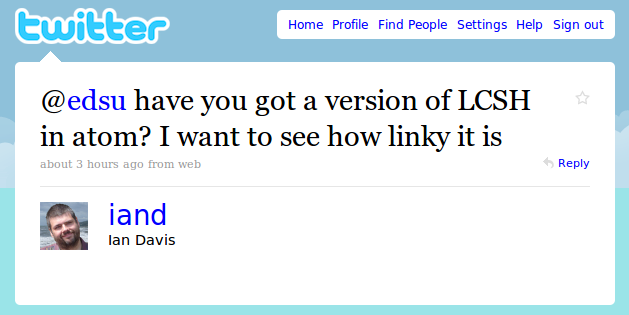
I know Peter Keane took a stab at this over the summer. But I couldn’t find sample output lying around on the web, so I marked up one by hand to serve as a strawman. So here’s the turtle for the LCSH concept “World Wide Web”:
@prefix rdf: <http://www.w3.org/1999/02/22-rdf-syntax-ns#> .
@prefix dcterms: <http://purl.org/dc/terms/> .
@prefix owl: <http://www.w3.org/2002/07/owl#> .
@prefix skos: <http://www.w3.org/2004/02/skos/core#> .

<http://id.loc.gov/authorities/sh95000541#concept>
    a skos:Concept ;
    skos:prefLabel "World Wide Web"@en ;
    dcterms:modified "2001-10-01T09:56:06-04:00"^^<http://www.w3.org/2001/XMLSchema#dateTime> ;
    skos:altLabel "W3 (World Wide Web)"@en, "WWW (World Wide Web)"@en, "Web (World Wide Web)"@en, "World Wide Web (Information retrieval system)"@en ;
    skos:broader <http://id.loc.gov/authorities/sh88002671#concept>, <http://id.loc.gov/authorities/sh92002381#concept> ;
    skos:narrower <http://id.loc.gov/authorities/sh2002000569#concept>, <http://id.loc.gov/authorities/sh2003001415#concept>, <http://id.loc.gov/authorities/sh2007008317#concept>, <http://id.loc.gov/authorities/sh2007008319#concept>, <http://id.loc.gov/authorities/sh2008009697#concept>, <http://id.loc.gov/authorities/sh97003254#concept> ;
    skos:related <http://id.loc.gov/authorities/sh92002816#concept> ;
    skos:closeMatch <http://stitch.cs.vu.nl/vocabularies/rameau/ark:/12148/cb13319953j> .
And here’s the “corresponding” atom:
<?xml version="1.0" encoding="utf-8"?>
<entry xmlns="http://www.w3.org/2005/Atom" xmlns:skos="http://www.w3.org/2004/02/skos/core#">
    <id>http://id.loc.gov/authorities/sh95000541#concept</id>
    <title>LCSH: World Wide Web</title>
    <author><name>Library of Congress</name></author>
    <updated>2001-10-01T09:56:06Z</updated>
    <skos:prefLabel>World Wide Web</skos:prefLabel>
    <skos:altLabel>W3 (World Wide Web)</skos:altLabel>
    <skos:altLabel>Web (World Wide Web)</skos:altLabel>
    <skos:altLabel>World Wide Web (Information retrieval system)</skos:altLabel>
    <skos:altLabel>WWW (World Wide Web)</skos:altLabel>
    <link rel="http://www.w3.org/2004/02/skos/core#broader" href="http://id.loc.gov/authorities/sh88002671#concept" title="Hypertext systems" />
    <link rel="http://www.w3.org/2004/02/skos/core#broader" href="http://id.loc.gov/authorities/sh92002381#concept" title="Multimedia systems" />
    <link rel="http://www.w3.org/2004/02/skos/core#narrower" href="http://id.loc.gov/authorities/sh2008009697#concept" title="Invisible web"/>
    <link rel="http://www.w3.org/2004/02/skos/core#narrower" href="http://id.loc.gov/authorities/sh2007008317#concept" title="Mashups (World Wide Web)" />
    <link rel="http://www.w3.org/2004/02/skos/core#narrower" href="http://id.loc.gov/authorities/sh2002000569#concept" title="Semantic Web" />
    <link rel="http://www.w3.org/2004/02/skos/core#narrower" href="http://id.loc.gov/authorities/sh2007008319#concept" title="Web 2.0" />
    <link rel="http://www.w3.org/2004/02/skos/core#narrower" href="http://id.loc.gov/authorities/sh97003254#concept" title="WebDAV (Standard)" />
    <link rel="http://www.w3.org/2004/02/skos/core#narrower" href="http://id.loc.gov/authorities/sh97003254#concept" title="WebTV (Trademark)" />
    <link rel="http://www.w3.org/2004/02/skos/core#related" href="http://id.loc.gov/authorities/sh92002816#concept" title="Internet" />
    <link rel="http://www.w3.org/2004/02/skos/core#closeMatch" href="http://stitch.cs.vu.nl/vocabularies/rameau/ark:/12148/cb13319953j" title="Web" />
    <link rel="alternate" href="http://id.loc.gov/authorities/sh95000541" type="text/html" />
    <link rel="alternate" href="http://id.loc.gov/authorities/sh95000541.json" type="application/json" />
</entry>
Maybe I botched something? It could use a GRDDL stylesheet I suppose. At
least the Atom
validates.
 I really am a bit conflicted posting any of this here because there is
so much about the Linked Data community that I like, and want to be a
part of. But I’m finding it increasingly difficult to see a Linked Data
future where RDF/XML is deployed all over. Instead I bleakly expect
we’ll see more fragmentation, and dueling idioms/cultures … and I’m
trying to see if perhaps things aren’t as bleak as they seem by grasping
at what the groups have in common. Maybe John Cowan’s idea (in the
comments)
of coming up with an RDF serialization that is valid Atom wasn’t so bad
after all? My apologies to any Linked Data folks who have helped me in
the past who may have been rubbed the wrong way by my last blog post.
I really am a bit conflicted posting any of this here because there is
so much about the Linked Data community that I like, and want to be a
part of. But I’m finding it increasingly difficult to see a Linked Data
future where RDF/XML is deployed all over. Instead I bleakly expect
we’ll see more fragmentation, and dueling idioms/cultures … and I’m
trying to see if perhaps things aren’t as bleak as they seem by grasping
at what the groups have in common. Maybe John Cowan’s idea (in the
comments)
of coming up with an RDF serialization that is valid Atom wasn’t so bad
after all? My apologies to any Linked Data folks who have helped me in
the past who may have been rubbed the wrong way by my last blog post.
Update: Sean Palmer clued me in to some earlier work he has done in the area of Atom and RDF, the Atom Extensibility Framework. And Niklas Lindström let me know of some thinking he’s done on the topic that is grounded in some work he has been doing for legal information systems in Sweden.